Luxembourgish surnames are a fascinating blend of Germanic, French, and Walloon influences, shaped by Luxembourg's trilingual heritage and its location at the crossroads of Europe. The majority of people bearing a Luxembourgish surname live in the Grand Duchy of Luxembourg, a small country in Western Europe. In Luxembourg, 36,000 distinct surnames names used before 1880 were registered as of 2009.[1]
History of Luxembourgish surnamesHistory of Luxembourgish surnames
Gravestone of Fr. Peter Hess (1828-1904) in the Peppange cemetery.
Starting as fief (county) of the Holy Roman Empire, Luxembourg has experienced dramatic border changes throughout its history; between 1659 and 1839, Luxembourg was divided into three parts. Over a span of 240 years, the three partitions together decreased the Duchy of Luxembourg's land area from 10,700 km2 to 2,586 km2 today. This, together with the country's location in the center of Western Europe, has influenced the Luxembourgish language, culture as well as its surnames, reflecting the country's Celtic, Gallo-Roman, and Germanic (Frankish) roots. Before surnames became hereditary, people often used descriptive information to distinguish between individuals with the same name; over time, these descriptive names became family names passed down through generations.
With a strong French and German influence, Luxembourgish surnames often adhere to naming norms comparable to those of other Western European nations. Usually chosen at the moment of birth, surnames are either the mother's, father's, or a mix of the two. The father's name used to be the primary basis for surnames, although current Luxembourgish law permits greater flexibility. Although changing a surname is allowed, "extraordinary circumstances" must often be proven. Authorities assess applications for name changes.
Types of Luxembourgish surnamesTypes of Luxembourgish surnames
Although Luxembourgish surnames frequently resemble German or French ones, they can also be a reflection of regional dialects, geographical characteristics, or past occupations.
Luxembourgish surnames of toponymic originLuxembourgish surnames of toponymic origin
Birth certificate of Félicie Schlesser. 1883.
These surnames refer to towns, regions, or landscape features, often with endings like -inger, -scheid, or -bach:
Kayser – possibly from a place or as a German form of Caesar
Remich – from the town of Remich
Wiltzius – from Wiltz, a northern Luxembourg town
Bofferding – from the village of Bofferdingen
Dondelinger – linked to Dondelange
Heiderscheid – from the village of the same name
Steinbach – “stone brook,” also a place name
Bivort – possibly from bivouac or a settlement by a fort
Thill – from a place meaning “ridge” or “hill”
Schieren – from the commune in central Luxembourg
Luxembourgish surnames of patronymic originLuxembourgish surnames of patronymic origin
These Luxembourgish surnames are derived from male ancestors’ first names, often with Germanic or Biblical roots:
Schmit – from Schmidt, “smith”
Jacobs – “son of Jacob”
Klein – “small,” also a common German-Jewish surname
Peter – from the biblical name Peter
Schreiner – “carpenter”
Michel – from Michael
Frantz – from Franz (Francis)
Hoffmann – “steward” or “farm manager”
Reuter – “rider” or messenger
Jung – “young” (possibly used to distinguish from elder family members)
Luxembourgish surnames of occupational originLuxembourgish surnames of occupational origin
A significant number of Luxembourgish surnames stem from trades or professions, often reflecting medieval society:
Schmit / Schmitt – blacksmith
Müller – miller
Fischer – fisherman
Weber – weaver
Becker – baker
Kammer – “chamberlain” or servant
Wagner – wagon-maker
Schneider – tailor
Metzler – butcher
Seiler – rope maker
Luxembourgish surnames of descriptive originLuxembourgish surnames of descriptive origin
Marriage certificate of Joseph Pascal Lebrun with Marie Jeanne Josépine Hedin, celebrated in Luxembourg on September 7, 1837
These surnames are based on physical characteristics or personality traits:
Klein – “small”
Gros – “large” (from French)
Lang – “tall” or “long”
Schwarz – “black-haired” or “dark”
Weiss – “white” or fair-skinned
Blum – “flower,” possibly a cheerful or attractive person
Freund – “friend,” may refer to a pleasant personality
Schön – “beautiful”
Rothe – “red” (hair or complexion)
Bongert – from orchard, possibly a landowner or farmer
Luxembourgish surnames of foreign originLuxembourgish surnames of foreign origin
Due to Luxembourg’s location and multilingualism, many surnames have French, Flemish, or Walloon roots:
Laurent – French form of Laurentius
Delvaux – “from the valley” (French origin)
Noesen – possibly from Belgian-Walloon origin
Goossens – Flemish patronymic (“son of Goos”)
Maas – from the Meuse River (Germanic and Dutch link)
Leclerc – “the clerk” (French occupational name)
Bastin – Walloon derivative of Sebastian
Simonis – Latinized form of “Simon”
Nilles – from Cornelius, used in both German and French
Delcourt – “from the court,” indicating noble service
Luxembourgish surnames of noble or aristocratic originLuxembourgish surnames of noble or aristocratic origin
Despite having a small population, Luxembourg has a strong aristocratic heritage, particularly considering that it is the only sovereign grand duchy still in existence. In Luxembourg, noble surnames usually come from European intermarriage with Belgian, French, and German nobilities, imperial service, or medieval landed family. Some examples are:
de Lannoy - old Walloon-Flemish nobility, with Luxembourgish branches. Some people claim the Delano family of former American president Franklin Delano Roosevelt is descended from the de Lannoy family, but no proof has been found yet.
d’Autel - landed aristocracy with lands in southern Luxembourg ad well as Lorraine (France)
d’Huart - noble family from the Moselle region, involved in government and diplomatic service during the Austrian and Prussian periods.
von Hohenstein - German noble house with Luxembourgish affiliations.
de Luxembourg - Refers to the House of Luxembourg, a major European royal dynasty in the Middle Ages. Members of this house ruled the Holy Roman Empire, Bohemia, and Hungary in different periods of time.
de la Fontaine - French-speaking noble family present in Luxembourg
de Villers - associated with the Knights Hospitaller and noble orders in Luxembourg and Lorraine
von Fischbach - From the village of Fischbach, where a favorite residence of the Grand Ducal family is located. The surname is used by nobles connected to the Grand Ducal court or associated service.
de Tornaco - Luxembourg-Belgian aristocracy. The Tornaco family produced several statesmen; Victor de Tornaco served as Prime Minister of Luxembourg (1860–67).
d’Olier - Possibly Huguenot-French nobility that settled in Luxembourg, associated with Enlightenment and early constitutional politics.
Most common Luxembourgish surnamesMost common Luxembourgish surnames
Celebrities with Luxembourgish surnamesCelebrities with Luxembourgish surnames
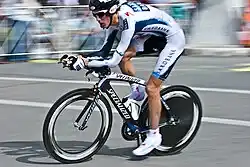
Andy Schleck.Josy Barthel - Luxembourgish athlete and politician, winner of the Men's 1500 metres at the 1952 Summer Olympics, and the only athlete representing Luxembourg to have won a gold medal at the Olympics
Jean-Claude Juncker - Luxembourgish politician who was prime minister of Luxembourg from 1995 to 2013 and president of the European Commission from 2014 to 2019. He also was Finance Minister from 1989 to 2009 and President of the Eurogroup from 2005 to 2013.
Andy Schleck - Luxembourgish former professional road bicycle racer. He won the 2010 Tour de France, and has also been the runner-up at the Tour twice; in 2009 and 2011.
Léa Linster - Luxembourgish chef, and a gold medal winner of the 1989 Bocuse d'Or, the first and to date only woman to accomplish this.
Michel Théato - Luxembourgish-born French long-distance runner, and the winner of the marathon at the 1900 Olympics in Paris running for France.
Désirée Nosbusch, also known as Désirée Becker - Luxembourgish actress and television presenter. She was the host of the Eurovision Song Contest 1984.