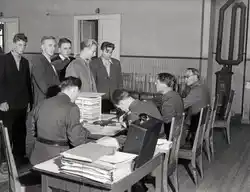
The kantakortti, or service record card[1], is a cornerstone of Finnish military history and genealogical research. This official, individual-centric document was created for every person who served in the Finnish Defence Forces, meticulously recording their military career from conscription to discharge, death in service, or retirement. Its comprehensive nature makes it an invaluable primary source for verifying service history, military units, ranks, and key career events.
Systematic creation of the kantakortti began for the 1897 birth cohort,[1] the first to be conscripted in independent Finland in 1919. This marked a significant shift towards a standardized national documentation system. The system established a unified administrative identity for citizens fulfilling their military duty, a clear break from the more fragmented practices of the Russian Grand Duchy era. While the system primarily covers those born in 1897 and later, exceptions exist for individuals born earlier who served in the Defence Forces' early years. The National Archives holds records for birth cohorts up to 1949; newer documents are stored elsewhere.
The true value of the kantakortti lies not just in its factual content but in its function as a "key" that unlocks more narrative sources, such as war diaries (sotapäiväkirjat) and daily orders (päiväkäskyt). By providing precise unit names and service dates, it acts as a navigational tool, allowing a researcher to place an individual within the context of broader historical events.
Research your ancestors on MyHeritage
Predecessors to the Kantakortti systemPredecessors to the Kantakortti system

Before 1919, Finnish military records were complex and decentralized.
- Swedish Rule (pre-1809): Records primarily consisted of unit-specific inspection rolls (katselmusrulla). These documents are held in the National Archives' Militaria collection, which largely contains microfilm copies of originals stored in Sweden's War Archives (Krigsarkivet).
- Russian Autonomy (1809–1917): The 1878 Conscription Act introduced a more systematic approach for the so-called "Old Army" (1881–1905). A pivotal development was the creation of conscription lists (kutsuntaluettelot), which documented all men of conscription age, not just those who entered active service. This marked a crucial shift from unit-centric to citizen-centric documentation, laying the groundwork for the individual-focused kantakortti. Finding records for Finns who served in the Imperial Russian Army is exceptionally difficult, as most of these archives were ceded to Soviet Russia under the Treaty of Tartu.

The Anatomy of the Finnish military service record cardThe Anatomy of the Finnish military service record card
Researchers will encounter two main types of kantakortti:
- The "Old" Kantakortti: This two-sided cardboard card was used before and during World War II. Information is organized into numbered fields, with the reverse side being crucial for tracking wartime service. For researchers, the most important fields are 23 (Entry into service) and 32–33 (Transfers and service history), which chronologically detail a soldier's path through various units.
- The "New" Kantakortti: Introduced after the wars, this is a greenish or bluish two-leaf booklet. These were often created by copying information from the old cards21. The most vital information is located on the second page under the heading.
"VI. Palvelus puolustusvoimissa" (Service in the Defence Forces)22. This section uses a clear, tabular format to distinguish between peacetime conscript service (marked "V"), paid civilian roles ("P"), and wartime service, making it easier to read than the old card. Because new cards are often copies, researchers should seek the original old card if any discrepancies are found, as it is the primary source for wartime events.
| Feature | "Old" Kantakortti (Pre/During WWII) | "New" Kantakortti (Post-WWII) |
| Physical Format | Two-sided cardboard card | Two-leaf booklet |
| Service History | Primarily in fields 23 and 32–33 | Section "VI. Palvelus puolustusvoimissa" |
| Layout | Based on numbered fields | Tabular with columns |
| Readability | Requires knowledge of the fields | Clear and chronological |
| Creation Method | Original entry | Often copied from the old card |
Accessing the ArchivesAccessing the Archives
Service details such as units, dates, and rank are public information. However, the full card becomes public only 50 years after the individual's death, in accordance with privacy laws.
- The National Archives (Birth cohorts up to 1949): The service cards for nearly all soldiers who fell in the wars of 1939–1945 have been digitized and are freely available through the National Archives' Astia online service. For non-digitized records, a request can be submitted via Astia, which requires strong Finnish electronic identification (e.g., online banking credentials). Records for those born in the 1940s are physically stored in Mikkeli, while older records are in Helsinki.
- The Military Medicine Archive (Birth cohorts 1950 and later): These records are held by the Military Medicine Archive in Viitasaari. Requests are primarily made through the Defence Forces' official e-service portal, which also requires strong electronic identification31. This requirement can pose a challenge for researchers living outside of Finland.
| Birth Cohort | Responsible Archive | Primary Ordering Method |
| Fallen in WWII (1939–45) | National Archives | Astia online service (digitized) |
| Born before 1940 | National Archives | Astia online service (information request) |
| Born 1940–1949 | National Archives | Astia online service (information request) |
| Born 1950 and later | Military Medicine Archive | Defence Forces' e-service |
Transformation of kantakortti from document to narrativeTransformation of kantakortti from document to narrative
The kantakortti is the starting point, not the end, of research. To understand the contents, one must decipher numerous military abbreviations34. The National Archives provides an essential PDF guide titled Sotilaslyhenteet (Military Abbreviations) for this purpose.
Once a soldier's unit and service dates are identified, the next step is to find the corresponding war diaries (sotapäiväkirjat). These daily logs, searchable by the full unit name (e.g., "Jalkaväkirykmentti 52") in the Astia service, describe the unit's movements and actions. By cross-referencing the kantakortti dates with the diary entries, a researcher can reconstruct the probable experiences of an individual, even if they are not mentioned by name.
This data can be further enriched by modern, collaborative projects like Sotapolku.fi, a website where users can input information from service cards to create a visual "war path" for individual veterans on a map39. Such digital humanities initiatives transform the administrative data of the kantakortti into a collective, public memorial, democratizing historical research for a new generation.
See alsoSee also
Explore more about Finnish military service cardsExplore more about Finnish military service cards
- Finland - Military record collection at MyHeritage
References
- ↑ 1.0 1.1 Finnish Army in World War II Database. Tampere University