An illustration entitled 'A vision of the repeal of the Window Tax' from Punch magazine
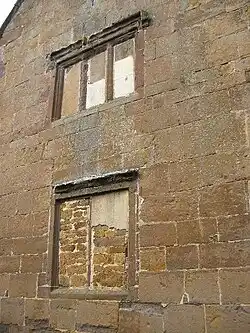
Window tax was introduced in England and Wales in 1696.[1] This was implemented to cover the financial losses due to the clipping of coinage where people were shaving precious metal from coins. It is also an example of wealth tax as, generally speaking, the wealthier a person was the more windows they would have. Window tax was banded according to the number of windows a property had. This meant the wealthiest member of society (or those with the most windows) would pay a higher rate of tax on having over ten windows. Window tax was seen by many as replacing the hearth tax, with the latter being discontinued in 1689. Hearth tax was invasive with officials needing to enter a person's property to check their claim. Window tax was much less invasive, with officials able to check a person's claim from the outside of a building. The tax lead to many households bricking up their windows to pay less tax, an architectural feature that can still be seen today in many historical buildings. Window tax was repealed in 1851, largely due to claims from doctors that lack of sunlight was damaging the health of the population.
Using Window Tax as a Genealogical SourceUsing Window Tax as a Genealogical Source
There are many benefits to finding an ancestor within window tax records, including the below:
Bricked up windows in Uppingham, RutlandThe window tax lists give the names of all heads of households who were required to pay, the parish of their residence, the number of windows they had and how much they were due to pay
Names sometimes include the terms 'Junior' and 'Senior' to distinguish between two men in the same parish. This hints at their relationship as father and son
In rare cases, a householder's occupation is given
If there is a good run of records for your ancestors parish over several years, you can potentially trace their increasing or decreasing wealth according to the number of windows they had and the rate that they paid. If you are aware that they remained in the same property at this time and the amount of windows change, this hints that they may have bricked up windows to pay less tax, or perhaps extended their house and increased the amount of windows they needed to pay for
You can compare the amount of windows your ancestor had to others in the same parish to gain an idea of their comparative wealth
Finding an ancestor tells you they were a resident of that particular parish on that date. This may help you to find further records. You may find they lived in several parishes, potentially appearing in window tax lists for different parishes over a period of time. The tax lists can help you to trace their movements, narrowing down the date that they relocated
Window tax lists are used by genealogists interested in tracking particular surnames. This also includes tracing variations in their spelling.
As well as window tax lists, you may also find surviving window tax receipts given to the householders. This acts as proof of payment. These provide the name of the householder, the amount that they paid, the amount of windows and the name of the tax collector
Issues with the England and Wales Window TaxIssues with the England and Wales Window Tax
All genealogical sources have potential issues to be aware of. Some of those associated with the window tax lists are:
Window tax lists have a low survival rate. Many parishes do not have any that survive at all. Where they do survive, they are not always in the relevant county archive, with some held in archives for neighbouring counties or even further afield.
Many people were exempt from paying window tax, including the poor, so it does not act as a complete census substitute of the householders population
Certain types of building were also exempt from the tax, such as churches and government buildings
A majority of lead occupiers named as paying window tax are male. Where women are named their full names are not always provided, named for example as 'Widow Jones'
Only the head of the household is named
Where to find England and Wales Window Tax recordsWhere to find England and Wales Window Tax records
Window tax lists do not survive as well as some other tax lists, such as land tax. A majority of those that have survived are held at county record offices. Others are held at The National Archives in Kew, most of which are in Series E 181. Very few are available online.