An illustration dated 1854 focussed around a hearth
A hearth tax was introduced in England and Wales in 1662.[1] The more hearths a household had, the more tax they had to pay. This tax was taken twice yearly at Lady Day (25 March) and Michaelmas (29 September). Duplicate copies of the tax lists were sent to the Exchequer, although there are known errors and omissions within these copies. Property owners were required to inform parish officials of how many hearths and stoves they had. If any officials wished to query this, they had the right to enter the property to check the accuracy of the property owner’s claims. As this was rather invasive and a confronting job for the parish officials, the hearth tax was eventually replaced by window tax. Hearth tax records can be used as a genealogical resource to find what parish a person was living in and how many hearths they had, which can hint at their wealth and status. The fee was paid by the property occupier. A majority of people are not named in hearth tax lists and most who are named are men. The tax was repealed in 1689.
Using the Hearth Tax as a Genealogical SourceUsing the Hearth Tax as a Genealogical Source
There are many benefits to finding an ancestor within hearth tax records, including the below:
Finding an ancestor tells you they were a resident of that particular parish on that date. This may help you to find further records. You may find they lived in several parishes, potentially appearing in hearth tax lists for different parishes over a period of time. The tax lists can help you to trace their movements, narrowing down the date that they relocated
If an ancestor had multiple hearths, particularly over five, this hints they were one of the wealthier members of society. You can compare their number of hearths to others on the same page from the same parish to see their social standing. Most people have one, two or three hearths
Where an ancestor is named in multiple returns over several years this can hint at their increasing or decreasing wealth depending on how their numbers of hearths changed over time
As well as focusing only on your ancestor, you can also see how the wealth of others in the parish changed over time
The hearth tax lists are one of many sources by genealogists interested in tracking particular surnames. This also includes tracing variations in their spelling.
Issues with the England and Wales Hearth TaxIssues with the England and Wales Hearth Tax
All genealogical sources have potential issues to be aware of. Some of those associated with the hearth tax are:
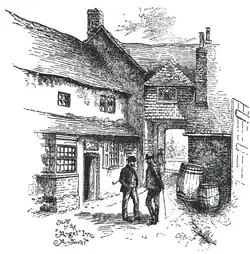
An illustration of The Angel Inn in Andover. Innkeepers had multiple hearths but were not particularly wealthyBelieving an ancestor to be very wealthy based on their number of hearths may be a mistake if they were an innkeeper. They are the exception to the rule.
Occupiers paid the tax, meaning wealthy landlords escape the charge on properties they were letting as this was paid by the current occupier
Only the head of the household is named
Relationships are only stated on rare occasions, and this is usually stating either 'Jr' or 'Sr', or 'Thomas Wright the younger' and 'Thomas Wright the elder' for example, hinting at parentage
Many people were exempt from paying hearth tax, such as the poor
An overwhelming majority of those named are men
Where women are named, their full names are often not given and are instead recorded as 'Widow Smith' for example.
There are few surviving exemption certificates and where they have survived they do not always state the reason for the exemption
There are few surviving hearth tax lists after 1674, despite the tax running until 1689
Where to find the England and Wales Hearth Tax recordsWhere to find the England and Wales Hearth Tax records
The National Archives, Kew
A majority of surviving hearth tax records at held at The National Archives in Kew in Series E 179. Some of the local copies that were taken can be found at county record offices, often among Quarter Sessions records. There are also many surviving exemption certificates naming those who are exempt from paying the tax found both at local archives and within E 179. Not all hearth tax records survive and survival rates vary by county. Radnorshire in Wales (now part of Powys) is believed to have the lowest survival rate. Some of the records have been digitised and transcribed and are now available online. One such example is the England and Wales, Hearth Tax, 1662-1674 collection at MyHeritage.
.jpg)