
The 1956 Hungarian Revolution was an uprising that occurred between the 23rd of October and the 4th of November 1956 against the Soviet-backed communist government in the Hungarian People’s Republic. Hungary had been pulled into the sphere of influence of the Soviet Union after the Second World War and could loosely be defined as a vassal of Moscow in the 1950s. The uprising began in October 1956 when Hungarian students began protesting about the way in which the communist regime was functioning in the country and the deeply repressive policies of the ruling Hungarian Working People’s Party. Hundreds of thousands of people revolted as the uprising grew. Moscow sent in over tens of thousands of soldiers and hundreds of tanks and brutally suppressed the revolution in late October and early November. Over 2,500 people were killed in suppressing the unrest, which had been crushed in Budapest by the 4th of November. Sporadic fighting continued outside of the capital for a week or so afterwards. Towards the end of the revolution and directly afterwards around 200,000 Hungarians fled from the country. Most migrated over the border to Austria from where many moved on again in 1957 to countries like the United States under the aegis of Operation Safe Haven.[1]
Research your ancestors on MyHeritage
1956 Hungarian Revolution chronology of events1956 Hungarian Revolution chronology of events
_t%C3%A9r_a_Luther_utca_fel%C5%91l_a_MDP_Budapesti_P%C3%A1rtbizotts%C3%A1g%C3%A1nak_sz%C3%A9kh%C3%A1za_fel%C3%A9_n%C3%A9zve._Fortepan_24492.jpg)
Hungary was one of the foremost allies of Nazi Germany during the Second World War. The country had been under military rule for most of the period since it became fully independent of Austria at the end of the First World War. The regent and quasi-military ruler of the country from 1920 onwards, Miklos Horthy, was a natural ally of the Nazis and the Hungarians gained from allying with Germany, acquiring lands lost to Romania and others after the First World War. In 1944 the Nazis took over control of Hungary more directly as Horthy’s reliability faltered. As the Soviet Red Army liberated the country late in 1944 and the first weeks of 1945 they began installing communist partisans into positions of power in the government.[2] However, contrary to some popular perceptions, communist regimes were only gradually established in countries like Romania and Hungary once the war ended. The communists lost the elections that were held in November 1945. It was only following fresh elections in 1947 that a communist government was established. Hungary was then transformed into a one-party state aligned closely with Moscow in the developing Cold War. In 1949 the Hungarian People’s Republic was declared.[3]
While the communists controlled Hungary in the 1950s, there was growing discontent underneath the surface about their actions. A large number of people were annoyed about the abandoning of private ownership and the imposition of communist economic ideology. Others protested the clamping down on freedom of expression, although Hungary did enjoy a relatively lenient environment in this regard. In 1955 Hungary also became a founding member of the Warsaw Pact of USSR-aligned nations in Eastern Europe.[4] At the same time, the general criticism of Joseph Stalin and the Stalinist regime even in Russia during the mid-1950s presented an environment where communist rule could be questioned. All of these factors led to student protests in the late autumn of 1956 and the outbreak of the Hungarian Revolution in October 1956.[5]
The Revolution lasted for around two weeks in its most confrontational stage. As the revolutionaries became more militant and began taking over buildings in Budapest and demanding sweeping political change, the communist government appealed to Moscow. Within days thousands of soldiers and hundreds of tanks were streaming into Hungary from the USSR and Warsaw Pact countries. The Revolution was violently crushed in late October and early November. Upwards of 3,000 protestors were killed in all, while hundreds of government aligned figures and soldiers also lost their lives. The wounded exceeded 13,000. Ultimately the Revolution failed completely in its aims and actually led to the development of a more repressive regime in the period that followed.[6]
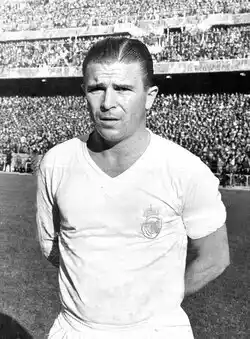
The suppression of the Hungarian Revolution also had cultural and social implications. In the 1950s the world’s leading football team were the so-called Mighty Magyars of Hungary, a team which included the best player in the world at the time, Ferenc Puskas. They had won virtually every game they played for years, claiming the gold medal at the 1952 Summer Olympics and the Central European International Cup in 1953. They crushed England 7-1 in 1954 and arrived to the World Cup in Switzerland that same year as the clear favorites. It was only through the ‘Miracle of Bern’, wherein West Germany came from two goals behind to win 3-2 in the final, that Hungary failed to become the World Cup champions. Two years later the Hungarian team split up and many players refused to play for the national team again after the Revolution, bringing to an end an era of Hungarian dominance with few equals in the annals of world football.[7]

Extent of migration caused by the 1956 Hungarian RevolutionExtent of migration caused by the 1956 Hungarian Revolution

As the Hungarian Revolution was crushed in the first days of November 1956 and in the weeks that followed approximately 200,000 people fled the country. They really only had one destination that was a viable option in order to get out from under communist rule. Hungary was bordered by either Soviet-aligned or dominated countries like Czechoslovakia and Romania or communist Yugoslavia, which steered a line independent of Moscow, but which was nevertheless considered a poor option for the Hungarian political refugees. By way of contrast, Austria, just to the west of Hungary, had become a neutral nation in the Cold War under the terms of the Austrian State Treaty that had finally been implemented in 1955 after many years of negotiation.[8] Therefore the overwhelming majority of the 200,000 Hungarians who fled the country as a result of the Revolution crossed the border into Austria. About 180,000 went to Austria and 20,000 crossed into Yugoslavia.[9]
The Austrian government was not delighted about this substantial influx of people into a country of just seven million people. Overnight it meant that one out of every 35 or so people in the country was a recently arrived political refugee from Hungary. The government in Vienna made it clear that it would welcome onwards migration to a third country. Several western governments facilitated this. The administration of US President Dwight Eisenhower initiated Operation Safe Haven within weeks and began flying out 27,000 Hungarian refugees to the United States. Another 11,000 were relocated in the year that following, meaning that nearly 20% of the overall number of Hungarians who fled in the wake of the violent suppression of the revolution ended up settling permanently in the US and adding the sizeable Hungarian American community there. Others moved onwards to countries like the United Kingdom, France and West Germany.[10]
Demographic impact of the 1956 Hungarian RevolutionDemographic impact of the 1956 Hungarian Revolution

The demographic impact of the Revolution mirrored this movement of people into Austria and then onwards again to third country destinations. Hungarians, for instance, are one of six officially recognized minority groups within Austria on account of their numbers being sizable enough in the country to warrant such special status. In the US the Hungarian American community is an estimated four million strong, while there are several hundred thousand people of Hungarian ancestry of any degree in the United Kingdom. In each instance the refugees of 1956 and their descendants only make up a small proportion of the communities involved. In the US, for instance, the bulk of the Hungarian American community is made up of people who are descendants are Hungarians that migrated to the country between the Hungarian Revolution of 1848 against Austrian rule and the outbreak of the First World War in 1914.[11]
An additional demographic impact of the Hungarian Revolution was the manner in which it convinced the Soviet Union and its communist allies in Eastern Europe that something needed to be done to stem to flow of people from their countries to the western world. There was a major flow of young working people from East Germany to West Germany also underway in the 1950s. In order to stem the losses, the government of East Germany began building the Berlin Wall in 1961, while the borders between Hungary and Czechoslovakia and countries like Austria and West Germany were secured against illegal migration. Therefore the Hungarian Revolution stemmed the movement of people from east to west in Europe for decades to come.[12]
See alsoSee also
Explore more about the 1956 Hungarian RevolutionExplore more about the 1956 Hungarian Revolution
- Hungary, Baptisms, 1734-1895 records collection on MyHeritage
- Hungary Reformed Church Christenings, 1624-1895 records collection on MyHeritage
- Hungary Catholic Church Records, 1636-1895 records collection on MyHeritage
- Hungary, Civil Registration, 1895-1980 records collection on MyHeritage
- Austria-Hungary, Roman Catholic Indexes, 1612-1966 records collection on MyHeritage
- Beginning Hungarian Genealogy at Legacy Family Tree Webinars
References
- ↑ https://www.wilsoncenter.org/article/looking-back-the-cold-war-1956
- ↑ Deborah S. Cornelius, Hungary in World War II: Caught in the Cauldron (New York, 2011).
- ↑ Stephen Kerttesz, ‘The Methods of Communist Conquest: Hungary 1944–1947’, in World Politics, Vol. 3, No. 1 (October, 1950), pp. 20–54.
- ↑ https://history.state.gov/milestones/1953-1960/warsaw-treaty
- ↑ Csaba Békés, ‘The 1956 Hungarian Revolution and the Declaration of Neutrality’, in Cold War History, Vol. 6 (2006), pp. 477–500.
- ↑ https://www.wilsoncenter.org/article/looking-back-the-cold-war-1956
- ↑ https://www.theguardian.com/football/blog/2020/nov/16/hungary-golden-squad-the-greatest-football-team-never-to-win-it-all
- ↑ https://2001-2009.state.gov/r/pa/ho/time/lw/107185.htm
- ↑ https://www.fmreview.org/resettlement/cellini/
- ↑ https://www.uscis.gov/about-us/our-history/stories-from-the-archives/operation-safe-haven-the-hungarian-refugee-crisis-of-1956
- ↑ https://guides.loc.gov/hungarian-americans/chronology
- ↑ https://www.stiftung-berliner-mauer.de/en/topics/berlin-wall