
The Montana Trail was a settler route that was developed and used by American settlers from around Salt Lake City in Utah north through Idaho to Montana in the days of the American West. It was primarily used in the 1860s, 1870s and 1880s, though it formed the basis for a lot of the movement between these parts of America for decades to come to populate the state of Montana. The Montana Trail developed as smaller gold rushes began in Montana and people who had initially moved from the Midwest to Salt Lake City took the trail northwards to Montana. Over a period of more than quarter of a century it led to Montana going from a region containing little more than a few hundred pioneer settlers at the start of the 1860s to having 20,000 in 1870, 39,000 in 1880, and more than 130,000 people in 1890, just after Montana became the 41st State of the Union. The Montana Trail was integral to the early settlement and history of the state of Montana.[1]
Research your ancestors on MyHeritage
The Montana Trail chronology of eventsThe Montana Trail chronology of events
The northwest of what is now the United States was one of the last regions of the continental US that experienced any major settlement in the nineteenth century. For instance, the period between the 1810s and the 1830s had primarily seen US westward settlement into places like the Great Lakes and west of the Appalachian Mountains into Kentucky, Tennessee and Alabama. Then, from the 1840s onwards, there was a lot of settlement into the Midwest and much further west between Texas and California, often fueled by things like the California gold rush of the late 1840s and early 1850s. The northwest didn’t have a huge allure for American and European settlers. By the start of the 1860s there were little more than a few hundred settlers in Montana.[2]

A number of things changed in the 1860s that led to the development of the Montana Trail and increased settlement in the region. Firstly, the Mormons had established Salt Lake City in Utah at the end of the 1840s and this was drawing a lot of new settlers to this part of the United States in the 1850s and 1860s. These people were then in close proximity when news started spreading about gold discoveries in Montana in the early 1860s at places like Grasshopper Creek. Within a few years the town of Bannack near Grasshopper Creek grew into the first major urban center in Montana.[3]
Further gold and silver rushes in Montana brought people to the region in the 1860s, 1870s and 1880s. In some ways the Montana Trail does not make sense geographically. If we look at it on a map it runs from Utah in the south north through Idaho and then into Montana. We might ask why this is? The issue is that there were conflicts to the east in the Dakotas between the Natives Americans there and the US federal forces, the Sioux Wars.[4] Therefore it was often safer to travel westwards from place like Missouri, Kansas and Colorado to Utah before turning north to Montana. The Montana Trail lasted in this way through the 1860s, 1870s and some of the 1880s. Then it declined as the Dakotas became safer to travel through and as railway lines running directly from the Great Lakes westwards to Seattle and other booming towns in Washington State were laid down. Nevertheless, the Montana Trail was critical in the early settlement of Montana and its creation as the 41st State in 1889.[5]

Extent of migration along the Montana TrailExtent of migration along the Montana Trail
So how many people actually travelled along the Montana Trail between 1860 and 1889? These are estimates, and are difficult to assess with accuracy given the lack of precise records, but historians believe that between 10,000 and 20,000 people travelled along the Montana Trail during this era. First this involved people going to Bannack and Grasshopper Creek. After the limited gold finds dried up here, hundreds started trekking north to places like Helena, the eventual state capital, and Virginia City. This movement of wagons and caravans was facilitated by Salt Lake City merchants and business people who provided building material and all manner of other goods that would be needed to settle in these new villages and towns in the new region. Livestock was also needed, most notably horses, cattle and sheep. Bison hunting became a major economic pursuit as well for those who arrived here.[6]
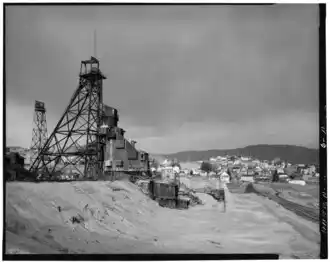
The mix of settlers could vary greatly. A lot of the people who were living in the northwest came from Scandinavia and parts of Northern Europe. There were even groups that came from rather unusual parts of the old world, like Montenegrins from the mountains of the Balkans and some settlers from Lebanon in the Levant. The most peculiar movement of all, though, was the influx of Irish settlers into the town of Butte in Montana. Butte was first settled in 1864. It grew substantially in the mid-1870s after new gold and silver mine seams were found. Later copper was found here and this turned Butte into one of the northwest’s great boom towns for a time.[7] The number of Irish who were drawn here was enormous. By 1900 there were 30,000 people in Butte. Nearly half of these were believed to be Irish. While cities like New York, Boston and Chicago are known today for their huge Irish American communities, it is actually Butte which is the most Irish city or town in the United States. A quarter of the population of the city are Irish Americans. The Montana Trail started processes like this in the northwest of the United States between the 1860s and 1880s.[8]
Demographic impact of the Montana TrailDemographic impact of the Montana Trail

The demographic impact of the movement along the Montana Trail was very substantial. Montana and surrounding regions of the northwest of the United States were some of the least densely populated parts of the country by the middle of the nineteenth century. Others experienced very swift settlement in the 1850s and 1860s like California and Texas. The situation in the northwest was slower and only occurred because of routes like the Montana Trail. By 1870 Montana’s population had increased to just 20,000. There were slightly more than 39,000 recorded in the 1880 census. The real explosion came in the final two decades of the century. The population more than trebled to over 130,000 by 1890 and then to 243,000 by 1900.[9] It reached half a million by the end of the 1910s and it took a century to reach one million people. Therefore, the real explosion of population growth in Montana took place between 1880 and 1920, fueled by the settlements established by pioneers who came to the region along the Montana Trail. This route played an integral role in the settlement of this rural state. It was only once the Montana Trail had turned the region into an attractive place for settlement that Montana became the 41st State in 1889.[10]
See alsoSee also
Explore more about the Montana TrailExplore more about the Montana Trail
- Montana Newspapers, 1890-2009 records collection on MyHeritage
- Montana, Marriages, 1889-1947 records collection on MyHeritage
- Montana, County Marriages, 1865-1950 records collection on MyHeritage
- Montana Deaths records collection on MyHeritage
- 1880 United States Federal Census records collection on MyHeritage
- 1900 United States Federal Census records collection on MyHeritage
- Montana Genealogy Treasures at Legacy Family Tree Webinars
References
- ↑ https://www2.census.gov/library/publications/decennial/1900/bulletins/demographic/33-population-mt.pdf
- ↑ https://www.pbs.org/wgbh/americanexperience/features/goldrush-california/
- ↑ Paul Meadows, ‘The Montana Story’, in Prairie Schooner, Vol. 22, No. 1 (Spring, 1948), pp. 20–25.
- ↑ https://www.oxfordreference.com/display/10.1093/acref/9780195071986.001.0001/acref-9780195071986-e-0618
- ↑ Helen McCann White, ‘Minnesota, Montana, and Manifest Destiny’, in Minnesota History, Vol. 38, No. 2 (June, 1962), pp. 53–62.
- ↑ J. M. Underhill, ‘The Northern Overland Route to Montana’, in Washington Historical Quarterly, Vol. 23, No. 3 (July, 1932), pp. 177–195.
- ↑ https://www.copper.org/publications/newsletters/innovations/1998/03/butte.html
- ↑ https://www.irishcentral.com/roots/america-most-irish-town-butte-montana
- ↑ https://www2.census.gov/library/publications/decennial/1900/bulletins/demographic/33-population-mt.pdf
- ↑ https://www.macrotrends.net/global-metrics/states/montana/population