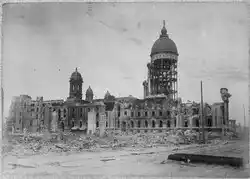
Genealogy researchers are bound to encounter record loss during their search journey. Some disasters were minor and resulted in a small percentage of vital records and other government records being destroyed. Others were on a more cataclysmic scale resulting in total loss of important records for family history research.
A record loss should never be seen as a "brick wall" or an impediment to research. Many records exist that can be used as "substitutes" for the lost records.
Research your ancestors on MyHeritage
United States Disaster ExamplesUnited States Disaster Examples
.jpg)
Here are a few notable disasters in the United States that have impacted the availability of records for research:
- 1890 Census Fires 1896 and 1921: The Census Bureau was actually plagued by two different fires including one in 1896 which damaged all of the Special Schedules (agriculture, mortality, business, etc.) and statistical information. The greater loss occurred on January 19, 1921 when a massive fire at the Commerce Building destroyed most of the 1890 Census population schedules. Out of 63 million names enumerated, only 6,300 - 0.0001 percent - could be salvaged.
- Ellis Island Fire 1897: On June 15, 1897 the entire building housing the immigration processing center, recently opened in 1892, was demolished by fire. Ellis Island would not reopen until December 1900. Records loss included all passenger lists for Ellis Island from 1892-1897 as well as all passenger lists for Castle Garden (the immigration processing center in use prior to Ellis Island) from 1855-1892.
- New York State Capitol Fire 1911: On March 29, 1911, the New York State Capitol in Albany, New York, suffered a disastrous fire. The State Library was located in the Capitol building and besides books, state archives documents were also stored at the library. Records loss included most colonial period files as well as state censuses, marriage bonds, and compiled genealogies.
- National Personnel Records Center Fire 1973: The fire on July 12, 1973 at the National Personnel Records Center in St. Louis, Missouri resulted in major losses to the Army and Air Force records. Over 18 million records were lost: 80% of US Army discharges from 1912-1960 and 75% of US Air Force discharges from 1947 to 1964.
- Courthouse Fires and Burned County Records: Across the United States many courthouses and local government offices suffered fires, notably during the 19th century and mainly in the South. Two notable examples include 1871 Chicago Great Fire and the 1906 San Francisco earthquake. Both of these disasters destroyed all city and county records since each city's founding. During the American Civil War, many courthouses in the South were subject to destruction by Union Forces, especially in Georgia and Virginia.

Substitute records for disaster-stricken locationsSubstitute records for disaster-stricken locations

All is not lost when it comes to locating information that perished due to lost records. Genealogy researchers need to be creative and seek out other record sets that could contain similar information and clues.
- Census records: Use federal and state census records to determine not only when a cluster of people died, but look for those family members left behind. Some households will be populated with a new configuration of relations such as cousins, aunts and uncles after a disaster. Also trace migrations to new locations, new occupations. In addition, most state censuses were taken "on the fives" meaning in a year ending in "5" and in between federal censuses
- City and business directories: Prepared on a yearly basis, city and business directories contain valuable information about the residents of a location often including name, address, employer, and even spouse's name. In addition look for common abbreviations such as "w" or "wd" for widow or widower and "bds" for someone who boards at an address. Keep in mind that the information in a directory was collected the year before the publication year.
- Classified ads: When disaster struck, many small town newspapers would see an increase in advertisements for estate auctions, missing persons, etc. Check newspaper records online and at repositories for information after a disaster.
- Court records: Many disasters resulted in lawsuits and court records. One example: lawsuits against a building owner for violating local fire codes resulting in a major fire such as the 1903 Iroquois Theater Fire in Chicago. Also check, wills, probate records, and estate records for victims.
- Diaries and letters: First person accounts of disasters by local residents as well as family members of the deceased will contain important information for research. While few of these records are found online, when visiting archives or repositories, as to check the vertical files which will contain family folders and documents.
- Mortality schedules: For the United States Federal census of 1850, 1860, 1870, 1880, and 1890 enumerators were asked to gather information on those who had died in the 12 month period prior to the census day. These census records are rich in information. Again, look for clusters of information to determine the casualties in a disaster.
- Necrologies: A necrology – a list of those who had died over a given period of time – was typically printed in local newspapers the first week of the new year for the year prior. These lists make it very easy to do cluster searches and correlate deaths to specific incidents.
- Obituaries: After a disaster, local newspapers will carry death notices and obituaries listing not only the victims, but friends and family members left behind.
- State level records: For records on a town or county level destroyed by a disaster, check the state archives for copies. Some states required local governments to send copies of local records to the state for safe keeping.
- Victims lists: Some local newspapers will list victims of a disaster as well as their obituaries.
Tips and TricksTips and Tricks
- Verify records loss: Don't assume that some or all records useful for genealogy research were destroyed once a disaster is identified. Contact the court house or governmental agency to confirm exactly the dates and the types of records lost.
- Search state and federal repositories: It was common for towns and cities to send copies of records to the state archives. In addition, states would often send copies of records to the Federal Government and these records are now managed by the National Archives and Records Administration.
- Check bordering areas: Search for records in nearby towns, cities, and counties. If an ancestor lived near a border, nearby locations could contain records and clues.
- Consult family members: There may be family stories about the disaster either written or part of your family's oral history. Gather clues by speaking with older relatives and family friends.
See alsoSee also
- Census records
- Ellis Island Immigration Records
- Castle Garden immigration records
- Obituaries
- Marriage records
- How to find old, obscure church records
- How to research ancestors who were lost at sea
- How to research ancestors who changed their names
- How to overcome genealogy brick walls
- Guide to abbreviations and key genealogy terms